HDB EV Charging in Singapore: What You Need to Know (2026)
- Go Electric
- Apr 4
- 5 min read
More than 80% of Singaporeans live in HDB flats. And until recently, that was the single biggest barrier to EV ownership for most of us — you can't plug in at home the way a landed homeowner can.
That's changing. Fast.
Here's a clear-eyed look at the state of HDB EV charging in 2026: what's available, what to expect, what it costs, and how to make it work.
The Ground Truth: Where Things Stand
Singapore's target is 60,000 EV charging points island wide by 2030 — 40,000 in public carparks, 20,000 in private premises. As of early 2026, around 15,300 points are installed. The ramp-up is real, but there's still a long way to go.
For HDB residents specifically:
Over 1,600 HDB carparks now have EV charging points installed
Every HDB town has been declared EV-ready, meaning at least some charging coverage exists
Charge+ — Singapore's largest operator — crossed 4,000 charging points in December 2025, with over 2,000 of those in HDB estates
Fast-charging hubs (50kW+) are coming to HDB estates. The first six locations will be operational by early 2027, operated by Shell and SP Mobility. LTA's plan is one fast-charging hub per HDB town by end-2027
The picture is improving. But the reality on the ground varies significantly by estate.
The Honest Challenges
Don't let the headline numbers obscure the practical friction.
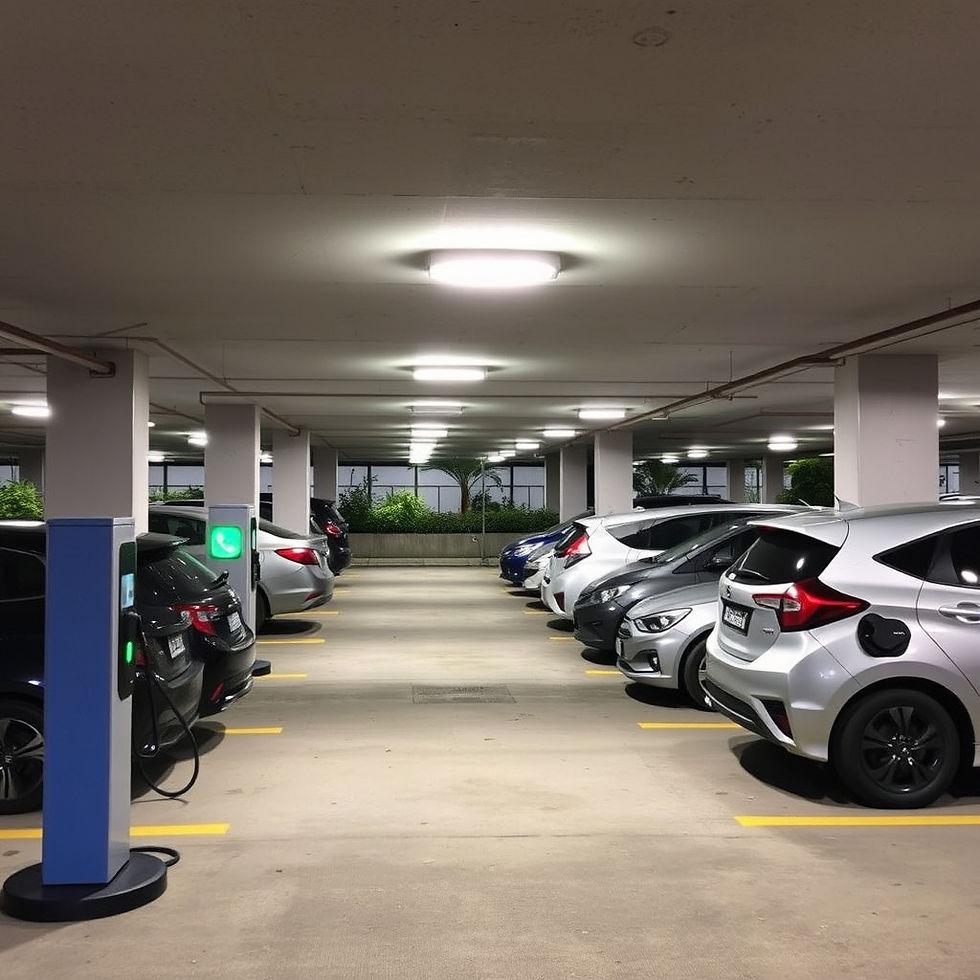
Coverage is uneven. Some estates have chargers in every block carpark. Others have a single cluster of chargers in the multi-storey carpark that fills up by 9pm. Before buying an EV, check the actual charger density at your specific carpark — not just your estate.
Slow chargers dominate. Most HDB chargers are 7.4kW AC units. That's fine for overnight charging — a full top-up takes roughly 6–10 hours — but it means you need to plan around charger availability. You can't nip down for a 20-minute top-up and expect meaningful range added.
You cannot install a private charger in a public HDB carpark. This is a hard rule. The lot you park in belongs to HDB/the Town Council. Only authorized operators can install equipment there.
Transformer and power supply constraints in older estates mean some carparks cannot simply be retrofitted — electrical infrastructure upgrades are needed before more chargers can be added. This is why the rollout isn't uniform.
Queue anxiety is real. At peak times — weekday evenings and weekends — popular charger locations in well-adopted estates can be occupied for extended periods. This is improving as density increases, but it's a legitimate consideration.
How Charging Works at HDB Carparks
Step 1: Find your charger Use apps like PlugShare, Charge+, SP Mobility, or Shell Recharge to locate the nearest available charger to your estate. Most operators have a live availability feature — use it before you drive down.
Step 2: Connect and authenticate Most HDB chargers use a QR code or RFID card to start a session. Download the operator's app in advance and set up your payment method before you need to charge in a hurry.
Step 3: Charging costs
AC (slow) charging: S$0.40–S$0.67/kWh depending on operator and time of day
DC (fast) charging: S$0.77–S$0.83/kWh at current HDB fast charger locations
Some operators (like SP Mobility) offer off-peak pricing — overnight charging can be meaningfully cheaper
Step 4: Don't overstay Charger hogging is a growing pain point. Once your car is charged, move it promptly. Some operators charge idle fees after the session ends.
What a Typical Month Looks Like for an HDB EV Owner
Say you drive 1,500km/month — roughly average for a Singapore private car owner.
A typical modern EV consumes around 15–18 kWh per 100km in Singapore conditions. So you'd use roughly 225–270 kWh per month.
At S$0.50/kWh average: ~S$113–S$135/month in charging costs.
The equivalent in 95-octane petrol for a car doing 14km/litre: roughly S$280–S$320/month at current prices.
The savings are real — roughly S$150–S$200/month. Over a year, that's S$1,800–S$2,400 back in your pocket.
The catch: those savings assume you can charge consistently and conveniently. If you're regularly driving to malls or paying for faster DC charging, your cost per kWh goes up.
What's Coming: Fast Charging in HDB Estates
This is the development that changes the HDB EV equation most significantly.
LTA's subsidiary EVe is rolling out fast-charging hubs — 50kW DC chargers — at HDB estate carparks near amenities like hawker centres and neighbourhood centres. The first six sites are in:
Bedok North Avenue 3
Plus five additional locations across the island
Each hub will have at least 6–8 charging points. At 50kW, a typical EV can add 100–150km of range in under 30 minutes. That's a fundamentally different experience from the existing slow-charge infrastructure.
With LTA's target of at least one fast hub per HDB town by end-2027, the convenience case for HDB EV ownership will look significantly stronger within 18 months.
Practical Tips for HDB EV Owners
1. Know your estate's charger density before you commit. Visit LTA's OneMotoring or Charge+'s map. Count the number of charging points within 200m of where you park overnight. If it's fewer than 6 and your estate has a high EV count, factor in queue friction.
2. Charge on weekday mornings or overnight. The 10pm–7am window sees the lowest utilisation at most HDB chargers. If your schedule allows for it, overnight charging is the most economical and convenient approach.
3. Use multiple operator apps. Charge+, SP Mobility, Shell Recharge, and CDG ENGIE each have different coverage areas. Don't rely on a single app — dead spots in one network are often covered by another.
4. Track charging costs separately. Most operator apps let you export charging history. After 3 months, review your actual cost per km versus your old petrol bill. The comparison is usually motivating.
5. Advocate for more chargers in your estate. Town Councils respond to resident requests. If your estate's coverage is thin, write to your TC — especially now, while deployment is still actively funded and expanding.
If You Live in a Condo, Not an HDB
The rules are different. You can push for shared EV charger installation through your MCST.
The EV Common Charger Grant (ECCG) co-funds 50% of installation costs per charger — up to S$4,000 for the first 2,000 chargers, S$3,000 for the next 1,500. As of early 2026, the grant is still available, but it closes at end-2026 or when 3,500 chargers are funded, whichever comes first.
The voting threshold to approve installation has also been lowered to 50% of subsidiary proprietors — making it easier to push through at your next AGM.
If you're a condo resident with an EV or planning to buy one: get this on the AGM agenda now.
Bottom Line for HDB Residents
Can you own an EV in an HDB flat in 2026? Yes — more comfortably than a year ago, and significantly more comfortably than 2027 will enable as the fast-charging rollout matures.
But go in clear-eyed: you are dependent on shared infrastructure, not a home wallbox. That means planning your charging routine, using the right apps, and accepting occasional inconvenience during peak periods.
For most HDB residents who drive regular distances for work and errands — and whose estate has reasonable charger density — the operational savings and day-to-day practicality stack up in EV's favour.
Check your estate's actual coverage. Then decide.
Sources: LTA, Charge+, HDB, Ministry of Transport Singapore. Figures accurate as of April 2026.

Comments